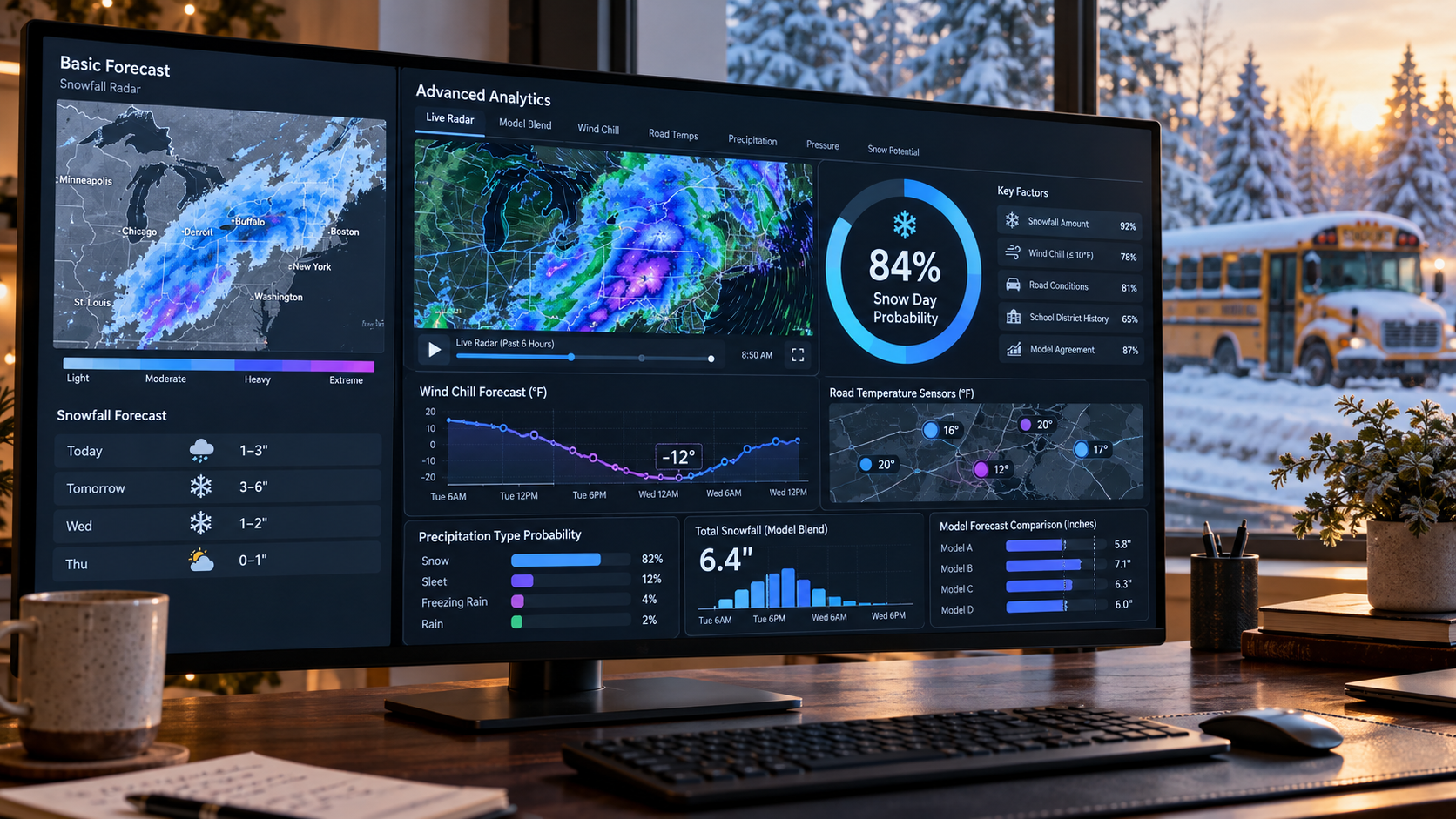
When winter storms approach, students and parents ask: what is the most accurate snow day calculator? Specifically, they want reliable prediction tools that forecast school closures before official announcements.
However, not all online calculators use the same underlying data. For instance, early web tools relied on simple static weather caches. In contrast, modern prediction engines evaluate live multi-factor forecast feeds. Consequently, choosing the right tool requires understanding how weather algorithms process storm data.
Comparing Algorithms: What Is the Most Accurate Snow Day Calculator?
First, determining accuracy depends on how an algorithm fetches data. Early online calculators utilized basic LAMP stacks that cached National Weather Service data at fixed 20-minute intervals.
Although caching handles sudden traffic surges during storms, cached feeds miss real-time forecast updates. Consequently, simple tools fail when weather conditions shift rapidly overnight.
Static NWS Weather Caches vs Real-Time Forecast Models
Specifically, basic tools only check predicted snowfall accumulation. For example, if a model sees 4 inches of snow, it outputs a static percentage score. However, real-world school closures depend on far more complex variables.
In contrast, advanced prediction engines analyze live, multi-variable data streams. Instead of relying on static snowfall depth, modern tools evaluate:
- Hourly Precipitation Rates: Snow falling at 1 inch per hour quickly overwhelms local plow fleets.
- Storm Commencement Timing: Snow arriving between 2:00 AM and 5:00 AM disrupts morning bus routes far more severely than afternoon snowfall.
- Freezing Rain and Sleet Warnings: Ice layers destroy road traction, making bus travel unsafe regardless of total snow accumulation.
Atmospheric Factors That Determine Prediction Accuracy
Furthermore, accuracy depends on evaluating atmospheric temperature profiles. For instance, high winds paired with freezing temperatures create dangerous wind chills. As a result, superintendents often close schools to protect walking students, even without heavy snow accumulation.
Evaluating Data Sources to Find What Is the Most Accurate Snow Day Calculator
Next, understanding meteorological limitations helps explain why prediction scores vary between sites. Indeed, predicting precipitation types near the freezing mark remains a major challenge in atmospheric science.
Landmark research in Nature Communications by DRI and UVM scientists evaluated forecasting precision. Specifically, researchers discovered that models struggle when surface temperatures hover between 30°F and 34°F (1.0°C to 2.5°C).
| Feature Metric | Basic Online Calculators | Advanced Multi-Factor Models |
|---|---|---|
| Data Refresh Rate | Static cache (20 to 60 minutes) | Near live hourly NWS graph feeds |
| Precipitation Analysis | Raw snow depth only | Snow, sleet, freezing rain, and black ice |
| Storm Timing Logic | 24-hour total sum | Hourly commute window evaluation |
| Extreme Cold Signals | Often ignored | NWS Wind Chill Advisory thresholds |
Snow Ratios, Ice Risks, and Freezing Point Limitations
At near-freezing temperatures, rain and snow share identical temperature profiles. Consequently, machine learning tools like Neural Networks only improved classification accuracy by 0.6% near 32°F.
Additionally, snow-to-water moisture ratios vary significantly between storms. Research from the University of Wisconsin-Milwaukee highlights that a 20:1 dry snow ratio behaves differently than a 5:1 wet slush ratio. Therefore, calculators that account for moisture density deliver superior reliability.
Brier Scores and Mathematical Verification in Weather Forecasting
To measure forecast quality objectively, meteorologists at institutions like Penn State Department of Meteorology use mathematical verification tools. Specifically, they calculate Brier Scores for probabilistic forecasts and Mean Absolute Error for temperature points.
Lower Brier Scores closer to 0 represent higher forecast precision. Modern calculators using live probabilistic forecasts achieve significantly better Brier Scores than static tools.
Diagnostic Checklist: Finding What Is the Most Accurate Snow Day Calculator
To determine if a prediction tool is reliable, check for these four critical features before trusting its score:
1. Live Weather Data Integration
First, verify whether the tool connects to live meteorological data. Reliable tools pull updated hourly forecasts directly from official National Weather Service feeds like the NWS Closing for Cold Guide.
2. Regional Preparedness Customization
Second, ensure the calculator factors in local geographic standards. For instance, southern school districts with limited equipment close after 1 to 2 inches of snow. Conversely, northern districts with extensive plow fleets require 5 to 6+ inches of accumulation.
3. Ice and Wind Chill Detection
Third, confirm that the engine evaluates ice and extreme cold. Freezing rain and dangerous wind chills frequently trigger closures without heavy snowfall.
4. Short-Term Lead Time Focus
Fourth, focus on short-term prediction windows. Forecasts within 24 to 48 hours offer 80% to 90% accuracy, whereas long-range estimates beyond 3 days remain uncertain.
Frequently Asked Questions: What Is the Most Accurate Snow Day Calculator?
What is the most accurate snow day calculator online?
The most accurate snow day calculator evaluates live multi-factor weather streams. Specifically, it accounts for snowfall intensity, freezing rain, wind chill, and storm timing rather than raw snow depth alone. As a result, tools utilizing live weather data feeds yield the most trustworthy probability estimates.
Why do some snow day calculators give different percentage scores?
Different calculators use varied data update frequencies and algorithm rules. For example, simple tools pull cached weather data every few hours. Conversely, advanced predictors process live National Weather Service hourly graphs.
How far in advance can a snow day calculator accurately predict closures?
Predictions within 24 to 48 hours achieve the highest accuracy rates. In contrast, forecasts beyond 3 days carry high uncertainty because winter storm tracks change rapidly.
Does freezing rain increase the accuracy of a closure prediction?
Yes, absolutely. Freezing rain and ice destroy bus tire traction instantly. Therefore, tools that track ice advisories accurately predict superintendents canceling school.
Conclusion: Choosing the Best Prediction Engine
Overall, asking what is the most accurate snow day calculator shows that live multi-variable data feeds deliver superior results over static weather caches. By evaluating snowfall rates, ice risks, wind chill, and regional infrastructure, modern predictors provide reliable planning guidance.
In summary, check prediction scores the evening before an expected storm, re-verify updated forecast data in the morning, and always confirm official schedule changes through your school district.