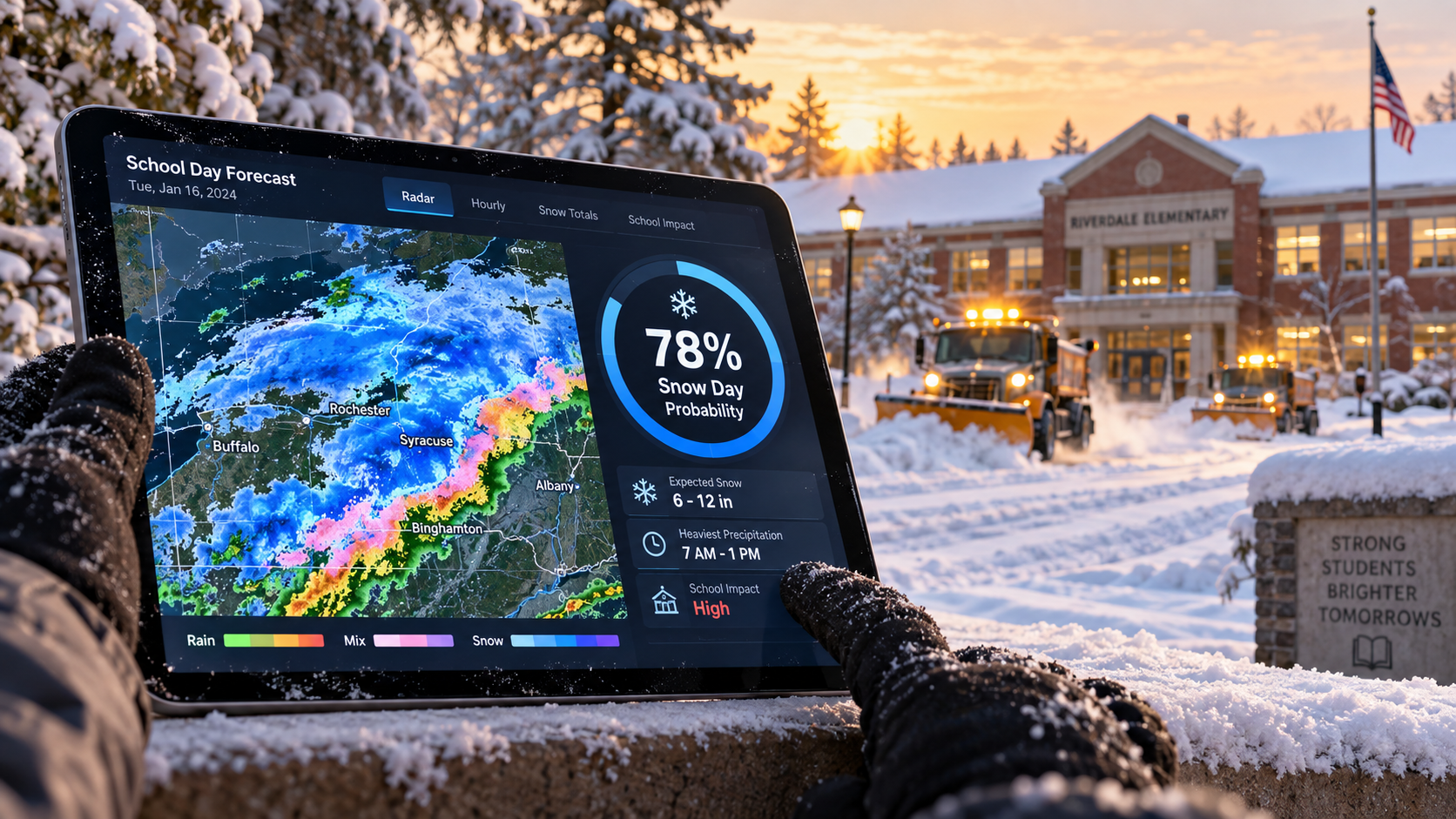
When severe winter weather approaches, millions of students ask: how accurate is a snow day calculator? Specifically, can digital algorithms reliably predict class suspensions?
For instance, checking an online prediction score late at night offers an exciting preview of tomorrow’s schedule. However, relying solely on raw snowfall forecasts often leads to unexpected surprises.
Today, modern prediction engines convert real-time atmospheric data into percentage likelihood scores. Nevertheless, determining true closure probabilities requires looking beyond basic accumulation depth. In addition, superintendents consider temperature dynamics, road clearing speed, and official district safety protocols.
Why Standard Snow Day Calculator Predictions Fail: The Root Cause
First, many basic online predictors fail because they treat weather forecasts as fixed guarantees. For example, early web tools built on basic LAMP stacks pull National Weather Service (NWS) data cached at 20-minute intervals.
Although caching protects core servers during heavy traffic spikes, automated data feeds cannot anticipate last-minute administrative decisions. Consequently, automated servers miss sudden schedule changes made by local superintendents.
Freezing Point Errors in Snow Day Calculator Accuracy
Specifically, the primary technical hurdle for standard calculators occurs during precipitation phase partitioning near the freezing mark. Indeed, landmark research published in Nature Communications by UVM and DRI scientists analyzed winter forecasting models.
The study showed that traditional models struggle when air temperatures hover between 30°F and 34°F (1.0°C to 2.5°C). At near-freezing temperatures, rain and snow share almost identical atmospheric profiles. As a result, weather models frequently misjudge the transition line between liquid rain and snow.
In fact, advanced machine learning tools only improved classification accuracy by 0.6% near 32°F. This occurs because surface weather data carries inherent physical overlap near the freezing mark.
Snow-to-Water Ratios and Moisture Prediction
Furthermore, standard algorithms fail when they ignore snow-to-water ratios. As atmospheric research from the University of Wisconsin-Milwaukee highlights, neural networks are necessary to predict variable moisture content.
For instance, a storm producing 5 inches of fluffy snow with a 20:1 ratio creates a specific road hazard. Conversely, 3 inches of heavy, wet slush with a 5:1 ratio creates far worse traction issues. Therefore, simple calculators that treat every inch of snow identically miss critical factors including:
- Freezing Rain and Black Ice: Sleet or ice layers destroy road traction far more dangerously than deep, dry snow.
- Extreme Wind Chill: High winds drop real-feel temperatures drastically. Consequently, districts close schools to protect students at bus stops even with zero snowfall.
- Forecast Lead-Time Decay: Short-term predictions within 24 to 48 hours achieve 80% to 90% accuracy. Meanwhile, long-range estimates beyond 3 days degrade quickly as storm tracks shift.
How Accurate Are Snow Day Calculator Algorithms? Science & Decision Protocols
In practice, school superintendents do not rely on basic weather apps when canceling classes. Instead, they consult local road crews, emergency management, and official tools like the NWS Hourly Weather Graph. Ultimately, educational leaders must weigh instructional time against student transit safety.
| Atmospheric Trigger | Administrative Action Protocol | Primary Safety Factor |
|---|---|---|
| Freezing Rain / Black Ice | Immediate closure or 2-hour delay | Bus traction failure and dangerous road conditions |
| Extreme Wind Chill | Full cancellation | Frostbite risk for outdoor bus stops and walking routes |
| 2″+ Snow Pre-5:00 AM | Plowing dispatched; 2-hour delay likely | Incomplete clearing of residential bus routes |
| 6″+ Heavy Accumulation | Formal Snow Emergency & Closure | Parking bans, active plowing, and emergency vehicle access |
Municipal Road Clearing and District Safety Standards
Generally, official municipal standards govern road clearing timelines. For example, the City of Red Wing Snow & Ice Control Policy outlines applying liquid salt brine 1 to 2 days before a storm. Specifically, this anti-icing treatment prevents ice from bonding to asphalt.
Subsequently, plows are dispatched when snow reaches 2 inches. In addition, full Snow Emergencies with mandatory street parking bans begin at 6 inches.
Similarly, DC Public Schools guidelines state that schedule decisions evaluate temperature, wind chill, snow depth, public transit, and storm timing. For instance, a 2-hour delay pushes morning schedules back without losing academic calendar days. In contrast, full snow days close facilities and require makeup days to satisfy state requirements.
Mathematical Verification of Weather Prediction Accuracy
To measure weather prediction accuracy objectively, meteorologists at Penn State University use specific mathematical verification metrics. Specifically, they calculate Mean Absolute Error for point forecasts and Brier Scores for probability predictions. As a result, lower Brier Scores closer to 0 indicate higher prediction accuracy.
Step-by-Step Protocol: How Accurate Is a Snow Day Calculator for Your District?
To accurately evaluate a prediction score, follow this 4-step diagnostic protocol rather than relying on a single raw number:
Evaluating Storm Timing and Road Pre-Treatment
- Analyze Storm Commencement Timing: First, storm timing often matters more than total snow volume. If heavy snow or freezing rain starts between 2:00 AM and 5:00 AM, road crews cannot clear neighborhood streets before bus runs. Consequently, this timing significantly increases closure chances.
- Audit Anti-Icing and Road Pre-Treatment: Second, check whether local road crews applied liquid salt brine before precipitation. Pre-treated pavement prevents snow from bonding to asphalt, allowing light snow to melt under normal traffic.
Checking Wind Chill Risks and Regional Preparedness
- Assess Wind Chill and Exposed Skin Risk: Third, review official wind chill advisories from the National Weather Service. Extreme wind chills create frostbite hazards for walking students and bus stops. Therefore, superintendents frequently cancel classes under these conditions regardless of snow accumulation.
- Factor in Regional Infrastructure Standards: Finally, adjust expectations based on local preparedness. For example, a 2-inch snowfall in southern districts with limited plow fleets triggers immediate shutdowns. In contrast, northern districts regularly operate through 4 to 5 inches of dry snow.
Frequently Asked Questions: How Accurate Is a Snow Day Calculator?
What factors make a snow day calculator more accurate?
A snow day calculator becomes significantly more accurate when it evaluates real-time, multi-factor forecast data. Specifically, taking into account live snowfall rates, freezing rain, wind chill, and storm timing rather than raw snow depth alone yields far more trustworthy probability estimates.
How many inches of snow does it take to cancel school?
There is no single universal snowfall threshold for canceling school. For instance, southern school districts with limited snow equipment may close after 1 to 2 inches of snow. Conversely, northern districts equipped with extensive plow fleets routinely require 5 to 6+ inches or active blizzard warnings.
Is 2 inches of snow a lot?
Whether 2 inches of snow is considered a lot depends on ground temperature, road treatment, and ice formation. Specifically, wet snow falling on frozen pavement with freezing rain produces hazardous black ice. Consequently, this condition frequently triggers delays or cancellations despite low accumulation depth.
Can ice cause a snow day without heavy snow?
Yes, absolutely. Freezing rain, sleet, and black ice cause far more travel disruption than dry snow. Indeed, ice destroys tire traction for school buses and passenger vehicles. Therefore, emergency managers prioritize road traction safety when making closure decisions.
Conclusion: Balancing Forecast Scores with Official Alerts
Overall, understanding how accurate is a snow day calculator highlights the impressive capabilities of modern weather modeling. However, no digital algorithm replaces an official announcement from your local school district or mayor.
In summary, predictive calculators serve as excellent early-planning tools by converting complex meteorological inputs into simple, readable scores.
For optimal planning, check prediction scores the evening before an expected storm. Subsequently, re-verify updated forecast data in the morning. Finally, always confirm final schedule changes through your school’s official communication channels.