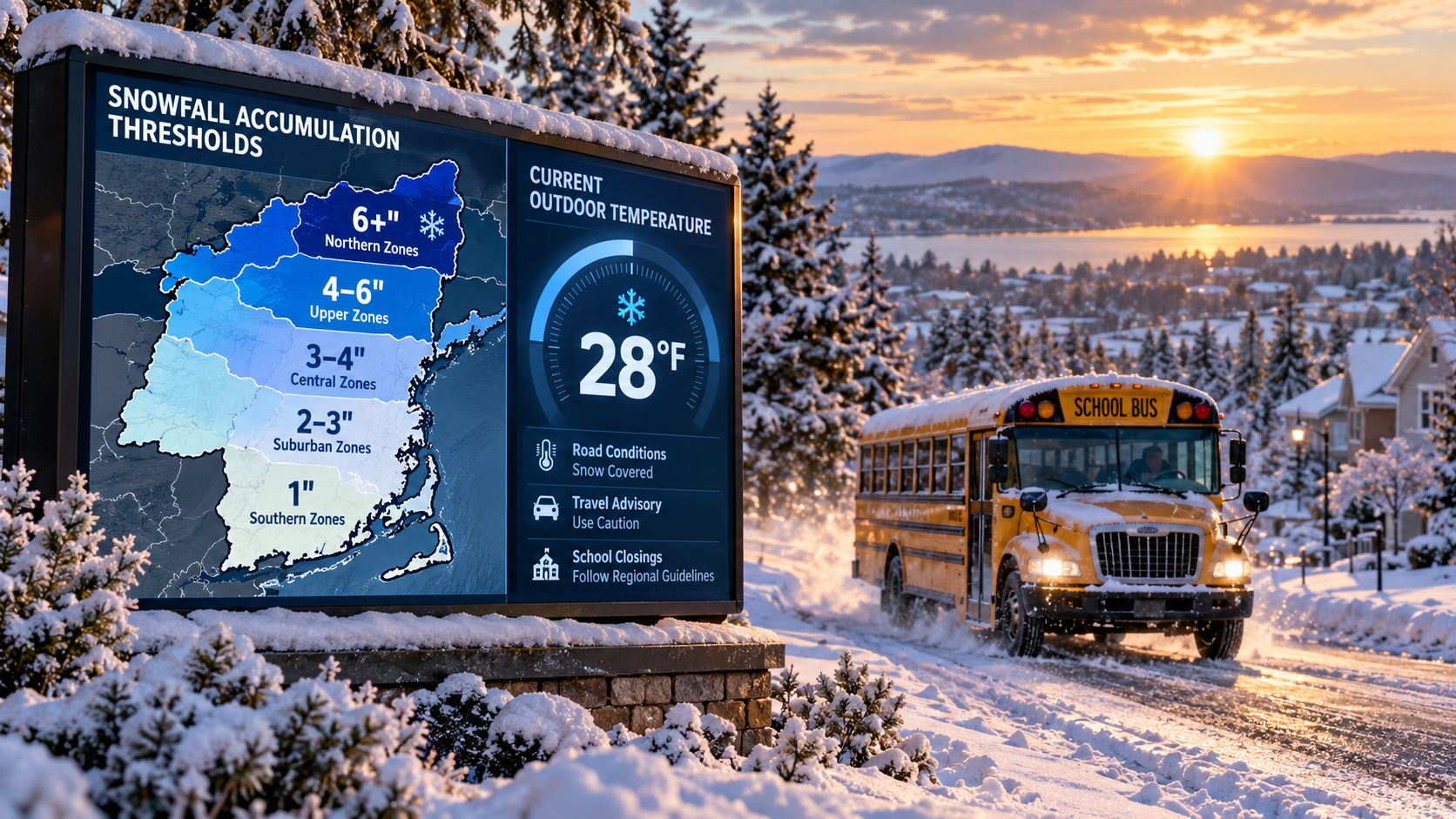
When winter storms gather on the horizon, parents and students ask: how much snow to cancel school? Specifically, everyone wants to know the exact accumulation depth that triggers a snow day.
However, there is no single universal number of inches that guarantees a cancellation. For instance, a 2-inch snowfall creates severe disruption in warmer regions. Conversely, northern communities routinely clear 4 inches before breakfast.
Indeed, understanding closure decisions requires evaluating local municipal plowing fleets, road anti-icing procedures, and official district safety protocols. Furthermore, factors like storm timing and extreme cold often matter far more than raw snow totals.
Why Fixed Accumulation Thresholds Fail: The Root Cause
First, expecting a fixed snowfall depth to dictate school closures ignores regional infrastructure differences. Specifically, school superintendents do not make decisions based solely on a ruler measurement.
Instead, administrative decisions depend on whether local public works crews can clear secondary bus routes safely. Consequently, identical snowfall numbers produce completely different results across the country.
Regional Preparedness and Municipal Plow Capabilities
For example, municipal snow control policies demonstrate these regional variances clearly. In Minnesota, the City of Red Wing Snow & Ice Control Policy applies liquid salt brine anti-icing mixtures 1 to 2 days before a storm.
This pre-treatment prevents ice from bonding to pavement. Subsequently, municipal plows begin clearing primary emergency routes at 2 inches of snow. Full snow emergencies and parking bans are declared at 6 inches.
In contrast, southern districts lack extensive salt trucks and municipal plows. As a result, even 1 inch of snow resting on untreated asphalt turns dangerous quickly.
The Science of Snow Ratios and Moisture Density
Furthermore, evaluating how much snow to cancel school requires analyzing snow-to-water moisture ratios. As atmospheric research at the University of Wisconsin-Milwaukee reveals, snow density varies dramatically between storms.
Specifically, 5 inches of light, dry powder with a 20:1 ratio blows off roads easily. Conversely, 3 inches of wet, heavy slush with a 5:1 ratio weighs down power lines and creates hazardous slush rutting. Therefore, treating all snow depth measurements identically leads to inaccurate assumptions.
District Guidelines: How Much Snow to Cancel School for Safety?
In practice, school superintendents consult local road crews, emergency management, and tools like the NWS Hourly Weather Graph. Educational leaders must balance mandatory instructional requirements against student transit safety.
| Regional Zone | Estimated Snow Threshold | Primary Administrative Trigger |
|---|---|---|
| Southern / Coastal Regions | 1 to 2 inches (or any ice) | Lack of local plows and untreated road freezing |
| Mid-Atlantic / Central Plains | 3 to 5 inches | Storm commencement timing during morning commute |
| Northern / Mountain States | 5 to 6+ inches (or blizzard) | Full Snow Emergency declarations and severe drifting |
| Nationwide Extreme Cold | 0 inches (Wind Chill dependent) | NWS Wind Chill Warnings below -20°F to -35°F |
Evaluating DC Public Schools Inclement Weather Guidance
For instance, guidelines from DC Public Schools Inclement Weather Guidance show how major urban districts evaluate winter storms. The Mayor and school officials review temperature, wind chill, snow depth, public transit availability, and storm timing.
When a 2-hour delay is declared, morning schedules push back without losing academic calendar days. In contrast, full snow days close facilities entirely and must be made up later to fulfill the state required 180-day instructional rule.
Dangerous Wind Chills and Freezing Rain Hazards
Additionally, superintendents frequently cancel school when zero snow has fallen. According to National Weather Service cold weather guidelines, severe wind chill values create frostbite risks for walking students within 30 minutes.
Similarly, freezing rain and sleet destroy bus tire traction instantly. Consequently, ice advisories cause school cancellations far more reliably than deep, dry snowfall.
Diagnostic Checklist: Evaluating How Much Snow to Cancel School
To accurately evaluate whether a winter storm will close your local school, follow this 4-step diagnostic protocol:
1. Analyze Commute Window Timing
First, check when heavy precipitation begins. If snow falls at 1 inch per hour between 2:00 AM and 5:00 AM, road crews cannot clear secondary neighborhood streets before morning bus runs. This timing significantly increases cancellation odds.
2. Audit Surface Temperatures and Ice Advisories
Second, review ground and air temperatures. Research published in Nature Communications by UVM and DRI scientists demonstrates that forecasts near 30°F to 34°F (1.0°C to 2.5°C) carry high uncertainty as rain transitions to snow. If freezing rain coats pavement, closures become likely regardless of depth.
3. Check NWS Wind Chill Advisory Limits
Third, consult official National Weather Service wind chill warnings. High winds combined with sub-zero temperatures force superintendents to close facilities to protect waiting bus riders.
4. Factor in Local Equipment Capacity
Fourth, adjust expectations based on local resources. Northern districts handle several inches easily, whereas southern districts close quickly due to limited plows.
Frequently Asked Questions: How Much Snow to Cancel School?
How much snow to cancel school in southern states?
In southern districts with limited plow fleets, as little as 1 to 2 inches of snow or a light layer of freezing rain can trigger immediate school cancellations.
How much snow to cancel school in northern states?
Northern districts equipped with heavy salt fleets and plows routinely operate through 3 to 4 inches of dry snow. Consequently, they usually require 5 to 6+ inches or active blizzard warnings to close.
Can ice cancel school without any snow depth?
Yes, absolutely. Freezing rain and black ice destroy school bus traction. Therefore, superintendents close schools for ice hazards even when zero snow accumulation is present.
Does a 2-hour delay count as a makeup snow day?
No. A 2-hour delay allows morning road crews to clear routes while preserving the required school day, avoiding additional makeup days at the end of the term.
Conclusion: Looking Beyond Snow Depth Numbers
Overall, asking how much snow to cancel school reveals that storm timing, freezing rain, wind chill, and regional plowing capacity matter far more than a single accumulation number.
In summary, predictive tools help families plan by evaluating live weather signals against regional safety rules.
For optimal planning, check prediction scores the evening before a storm, re-verify updated forecast data in the morning, and always confirm final schedule changes through your official school district alerts.